Sponsorship Disclosure
Content created through Jestr campaigns is sponsored content and should be appropriately disclosed by creators.
This includes performance-based campaigns. Even though creators aren't being paid a fixed fee for a video, they have the opportunity to earn money based on the performance of their content.
Disclosure requirements can vary depending on a creator's location, platform, and applicable regulations, so there isn't a single disclosure format that Jestr can prescribe for every creator and campaign.
Jestr's disclosure guidance
Every Jestr campaign includes access to our Sponsorship Disclosure Guide as a baseline resource for creators.
The guide brings together general disclosure guidance by region alongside platform-specific information for TikTok, Instagram, and YouTube.
Jestr Sponsorship Disclosure Guide
This resource is provided for educational purposes and isn't legal advice. Disclosure rules and platform requirements can change, and creators should research and understand the requirements that apply to their content and location.
Where applicable, we encourage creators to consult the official guidance published by the relevant regulators and platforms.
Disclosure isn't automatically enforced by Jestr
Jestr does not automatically review or approve every creator submission for compliance with advertising disclosure requirements.
As a marketplace connecting studios and creators, we provide creators with disclosure resources and give studios tools to communicate their own requirements, but we don't determine whether an individual piece of content satisfies every law, regulation, or platform policy that may apply to it.
Creators should understand and follow the disclosure requirements applicable to their content, while studios should communicate any additional campaign-specific requirements they need creators to follow.
Adding custom disclosure requirements
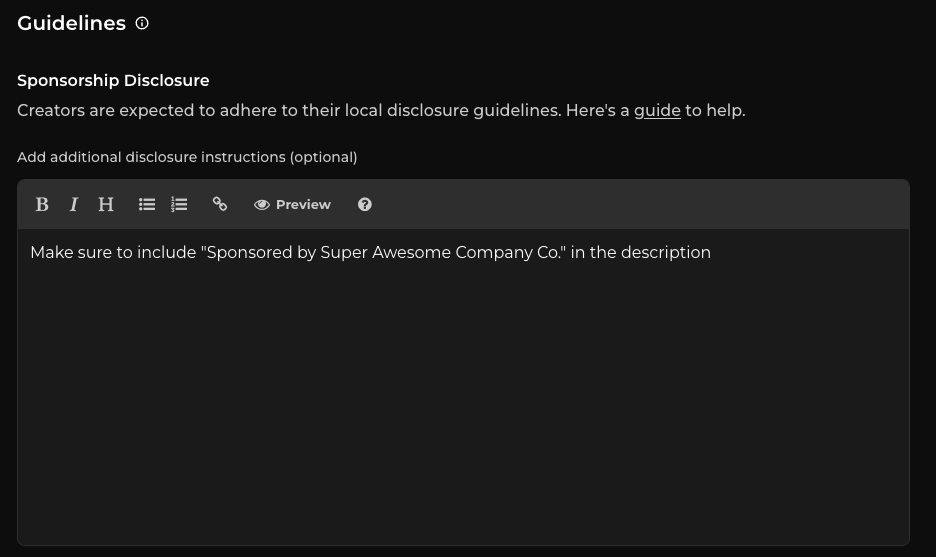
In addition to Jestr's general disclosure guidance, you can provide custom disclosure instructions when creating your campaign.
For example, your campaign may require creators to include:
- A particular disclosure term such as #ad or #sponsored
- A campaign-specific tag such as #GameNamePartner
- A particular disclosure statement
- A platform's native paid partnership or sponsored content tools
- Other disclosure language required by your studio, publisher, or campaign
These instructions are shown to creators alongside the rest of your campaign requirements.
Keep custom requirements clear
If you have specific requirements, make them explicit and easy for creators to follow.
Rather than writing a long legal explanation, clearly state what you need creators to include and where you expect it to appear.
The goal isn't to minimize disclosure. It's to make proper disclosure as straightforward as possible for creators while avoiding unnecessary complexity that makes campaign participation harder.
Platform disclosure tools
TikTok, Instagram, and YouTube each provide their own tools for identifying sponsored or paid content.
Depending on the creator's location and circumstances, using a platform's built-in disclosure tool may not necessarily be the only disclosure required.
Jestr's Disclosure Guide includes platform-specific information to help creators understand the tools available to them, but creators should always verify the current requirements that apply to their content.
View platform disclosure guidance
What if a submission is improperly disclosed?
If you believe a creator's submission doesn't meet the disclosure requirements for your campaign, you can flag the submission for Improper Disclosure.
While a submission is flagged, it isn't eligible for payment.
The creator can then make the appropriate changes and submit an appeal explaining what they've changed. Your team can review the updated submission and either lift the flag or continue the discussion.
Because a flag affects creator rewards, it should be used when you have a genuine disclosure concern rather than as a way to request unrelated creative changes.
For more information, see Flags & Appeals.
Disclosure requirements can change
Advertising regulations and platform policies aren't static.
Jestr's Disclosure Guide is intended to make commonly relevant information easier to find, but it shouldn't be treated as the definitive or permanent source of disclosure requirements.
Creators and studios should do their own research and consult current official guidance when determining what applies to a particular campaign, platform, or region.
That's it for Core Concepts
You now have an overview of the fundamental systems behind Jestr campaigns — from campaign timing and visibility through submissions, creator rewards, guidelines, keys, and disclosure.
You don't need to memorize every concept. These pages are designed to act as a reference whenever you need to understand a particular part of how Jestr works.
Next: Billing & Payments
With the campaign mechanics covered, the next section explains the financial side of running campaigns on Jestr.
Learn how campaigns are funded, how invoices and payments work, how Jestr Credits can be used across campaigns, and what happens to unused funds after a campaign ends.
Continue to Billing & Payments for a complete overview.